

To the casual observer, the numbers may seem dire.
PwC’s latest healthcare outlook projects a 9% increase in group medical costs for 2027. Hospital reimbursement pressure, changes in billing practices, and growing demand for behavioral health services all contribute, but ballooning pharmacy costs are another major driver. The good news is that with a bit of work, there are meaningful opportunities for employers to bring them under control.
Especially for self-funded employers, these pressures raise difficult questions: how much more can the organization absorb, and what will employees be asked to pay? Another expensive renewal season can make rising costs feel inevitable, but employers are not without options. By choosing a PBM partner that consistently pursues lower-cost, clinically appropriate options and helps members access the medications they need, employers can begin to bring pharmacy spending under control while delivering a better experience for their members.
DisclosedRx is a PBM that demonstrates that “bending the curve” of rising pharmacy costs is possible. In 2026, DisclosedRx reported a 24.9% decline in plan-paid pharmacy costs per member per month (PMPM) across its book of business. These results offer a counterweight to the assumption that every plan must follow the market upward.
Why are pharmacy costs rising faster than other healthcare costs?
Milliman projects pharmacy costs will increase 14.8% in 2026 for the average person in its modeled employer-sponsored health plan, making pharmacy its fastest-growing cost category. Business Group on Health reports that pharmacy accounts for 25% of surveyed employers’ total healthcare spending.
This cost growth isn’t inherently evidence of a poorly managed benefit. Some of it reflects advances in treatment, such as high-cost specialty drugs for serious illnesses. GLP-1 medications are reaching more patients, but as their uses expand, so too does spending growth.
How a PBM purchases and pays for those medications also affects the employer’s bill. Formulary choices, dispensing channels, and rebate arrangements all influence the final cost. A large rebate may look reassuring in a renewal presentation, but employers should expect their PBM to show how the cost after rebates compares with clinically appropriate alternatives. They should also understand how much of their spending the PBM retains.
Spread pricing is one way PBMs retain a portion of that spending: the PBM charges the plan more than it pays the pharmacy and keeps the difference. In its January 2025 interim staff report, the Federal Trade Commission estimated that the three largest PBMs generated $1.4 billion in spread-pricing income on the specialty generic drugs it examined during 2017 through part of 2022. That expense buys no additional medication for the member, so employers should question what value they receive in return.
What does DisclosedRx’s performance show?
DisclosedRx’s reported 24.9% decline in plan-paid PMPM is worth examining because it follows spending through to the employer’s expense. A favorable discount or rebate guarantee matters only to the extent that it contributes to an affordable, effective benefit. The plan’s actual spending is where the rubber meets the road.
Specialty spending is another strength for DisclosedRx. UnitedHealthcare reports specialty medications accounted for approximately 55% of employer drug spending in its 2025 data. By contrast, DisclosedRx reports a specialty share of 42% of total plan-paid pharmacy spending. Client populations and accounting methods may differ, but the smaller share is encouraging when considered alongside DisclosedRx’s declining overall PMPM.
How do those results translate to individual employers?
A construction and maintenance company faced rising pharmacy costs associated with specialty therapies and GLP-1 medications. It introduced a DisclosedRx-managed pharmacy benefit as part of a broader benefits redesign. Savings Advocates reviewed high-cost prescriptions and helped eligible members pursue available savings pathways.
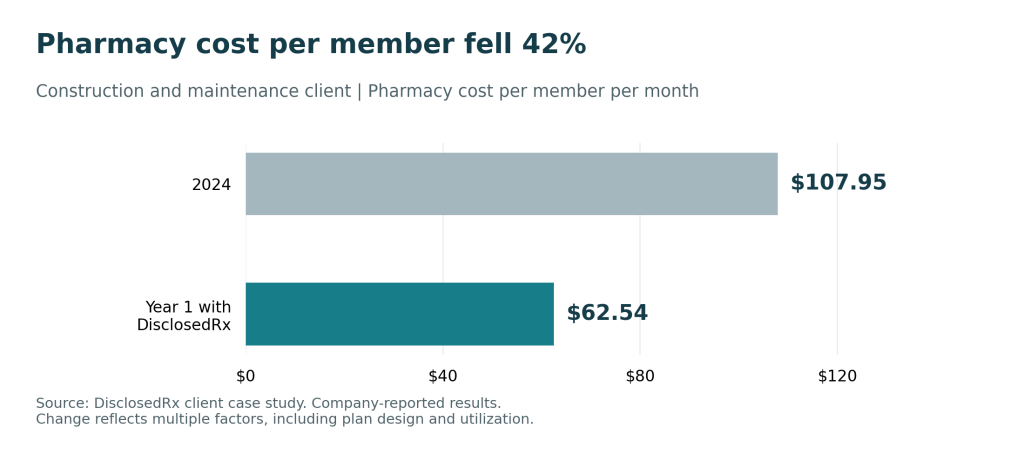
The company’s pharmacy PMPM fell from $107.95 in 2024 to $62.54 in Year 1, a 42% reduction. The case study attributes that change to several factors, including the Savings Program, an 87% generic fill rate, managed GLP-1 utilization, plan design, and member utilization. The result reflects that broader effort, rather than the Savings Program alone.
Within that experience, DisclosedRx documented $327,586 in savings across 482 prescription fills. The plan received $316,071 in savings, and members saved $11,515. For an employer, that is a compelling argument for expecting its PBM to work at the prescription level. An aggregate cost report cannot do that work on its own.
A second case study, involving a 290-member manufacturing and industrial plan, compared 2025 costs with annualized projections based on January–May 2026 experience. Total pharmacy PMPM, including plan and member costs, decreased from $150.54 to $89.64 in that comparison. Annualized spending on the client’s 20 highest-cost drugs was 41.2% lower, representing $170,116 in projected annual savings.
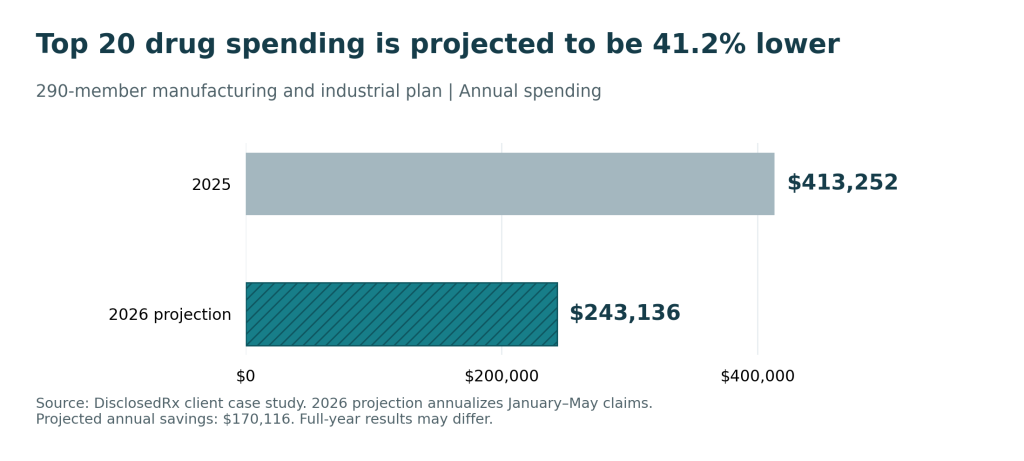
These are individual client experiences, and the second study’s annualized figures remain projections; full-year results will depend on subsequent claims and utilization. They do, however, show why an employer should expect its PBM to explain what it has done to reduce costs.
What changes can help control pharmacy spend?
Much of this work requires persistent attention to details and decisions that can become routine.
- A formulary should not carry forward unquestioned simply because it was acceptable last year. A preferred drug should earn its place through clinical evidence and its cost after rebates and fees. Employers should expect their PBM to revisit those decisions when pricing changes, or a suitable alternative becomes available.
- Generics and biosimilars can be part of that review. FDA-approved biosimilars have no clinically meaningful differences from their reference products and may offer lower costs. Whether a particular option saves a plan money still depends on its actual pricing and benefit arrangements. An employer needs to know what a switch would cost and how members would be supported through it.
- High-cost prescriptions also warrant review of eligible savings programs and dispensing options. In the construction company’s case, alternative sourcing accounted for approximately $259,000 in documented plan savings. Manufacturer copay cards and coupons contributed approximately $56,000.
What about Member Services?
Member support deserves to be judged as part of the total analysis. DisclosedRx’s Savings Advocates help members navigate paperwork, coordinate with prescribers, and obtain their medications when pursuing a lower-cost option. A savings opportunity has little value unless coupled with a “member-first” experience that helps members through the process.
What should employers ask their PBM before renewal?
The PBM’s compensation should be clear. DisclosedRx receives 100% of its revenue from clients, with all rebates passed through, fully disclosed fees and no third-party revenue. This gives employers a clear place to start when assessing incentives: the client pays for the service and can examine each charge in detail, and the PBM can demonstrate that its work justifies the expense.
A market forecast can help an employer’s budget, but it shouldn’t become a standing explanation for every increase. Ask the PBM to use the plan’s own claims to explain which medications drove the change in spending and which interventions reduced it. Request the cost after rebates and all applicable fees, with the same definitions used in each comparison period. Changes in enrollment, coverage, and utilization should be explained alongside financial results.
Member costs and access belong in that review. Lower plan spending needs to be considered alongside any changes in members’ out-of-pocket expenses or their ability to obtain treatment. Reporting should distinguish completed savings from opportunities still awaiting action.
Rising healthcare costs make the choice of a pharmacy benefit partner more consequential than ever before. DisclosedRx’s results show what active management can accomplish when lower costs and member support are treated as shared priorities. For self-funded employers facing another expensive renewal, now is the time to examine what that approach could mean for their own plan.
Talk with DisclosedRx about your pharmacy spending, the opportunities to reduce it, and how to help members access the medications they need.